

A rubber strap is better than a metal bracelet in a hot climate when you prefer a flexible band without articulated links, but it is not automatically cooler or more breathable. For your 2026 choice, the main caveat is trapped perspiration: a close-fitting rubber strap still covers your skin, while a well-adjusted metal bracelet can remain comfortable throughout the day.
- Rubber strap vs metal bracelet hot climate: choose by fit and moisture management, not material alone.
- Rubber suits wearers who prefer flexibility; metal suits wearers who value bracelet articulation and its original appearance.
- ZERATI offers Swiss-made FKM rubber straps for Rolex owners; exact watch and clasp compatibility still need checking.
- Neither rubber nor metal compensates for an overly tight fit or perspiration left against your skin.
Is a rubber strap better than a metal bracelet in hot climates?
Choose rubber for its flexible feel, not a promise of a cooler wrist. Choose a metal bracelet if its articulation, adjustment and appearance already work for you. Heat alone is not a reason to replace a comfortable bracelet.
ZERATI supplies Swiss-made FKM rubber watch straps designed for luxury timepieces. That makes rubber a relevant alternative for Rolex owners, but the material description does not settle the comfort comparison.
| Hot-weather consideration | Rubber strap | Metal bracelet |
|---|---|---|
| Best for | Wearers who prefer a flexible band and a sportier appearance | Wearers who prefer articulated links and the bracelet appearance |
| Contact with skin | A continuous surface can hold perspiration beneath it | Links create separate contact surfaces, but moisture still collects underneath |
| Temperature sensation | Rubber transfers heat less readily than metal | Metal transfers heat more readily, making temperature differences more noticeable |
| Adjustment | Depends on the buckle, clasp and strap design | Depends on the clasp, links and any adjustment mechanism |
| Cleaning | The underside, edges and fastening need attention | Link gaps, the underside and clasp need attention |
| Main limitation | Flexibility does not make rubber breathable | Articulation does not guarantee a comfortable fit |
The comparison changes with construction. A broad rubber strap worn tightly and a loosely articulated bracelet do not cover the wrist in the same way; neither represents every example of its material.
Why this matters
Hot-weather comfort has several separate causes: temperature sensation, retained moisture, pressure and watch movement. Treating all of them as a material problem leads to the wrong purchase.
For a Dubai commute in 2026, assess the watch both outdoors and in air-conditioned surroundings. A bracelet that feels cool when first picked up tells you little about how it fits after your wrist becomes warm. Likewise, a rubber strap that feels soft in your hand still needs to sit comfortably beneath the watch head and fastening.
Fix the fit before changing the material. If your bracelet already stays secure without pinching, rubber is an alternative wearing experience rather than a necessary hot-weather upgrade.
Rubber straps: best for flexibility, not guaranteed ventilation
A rubber strap bends as a continuous band rather than through linked joints. If you dislike the sensation of bracelet edges or links against your wrist, that difference is a practical reason to try rubber.
Rubber is not breathable in the way an open textile is. Perspiration can remain between the strap and your skin, especially where the underside sits flush. Channels or shaping change the contact pattern, but you should check the actual design rather than assume every rubber strap includes them.
FKM identifies a family of fluoroelastomer materials. It does not specify the finished strap's thickness, underside geometry, adjustment range or compatibility. Those details need separate attention.
Recommendation: choose rubber if you prefer its flexibility and accept regular underside cleaning. Do not choose it solely because a listing uses the words heat-resistant; material heat resistance is not a measurement of wrist comfort.
Metal bracelets: best for articulation and bracelet appearance
A metal bracelet remains a sound hot-climate choice when its links move freely and its clasp provides a suitable fit. You do not need to abandon the bracelet appearance to wear a Rolex comfortably in warm weather.
Metal conducts heat more readily than rubber. That explains why a bracelet's initial temperature feels noticeable against your skin; it does not prove the bracelet will remain hotter or colder throughout wear. Direct sunlight, surrounding air and contact with your wrist all affect its temperature.
The practical drawback is cleaning between components. Perspiration and residue reach the spaces around links and the clasp, so wiping only the visible outer surface leaves part of the job unfinished.
Recommendation: keep the metal bracelet if adjustment resolves the discomfort. If your particular clasp includes an adjustment mechanism, learn its operation before deciding that the material is the problem. Do not assume every Rolex bracelet has the same mechanism.
Why hot-weather comfort varies
These factors explain more than a simple rubber-versus-metal label:
- Fit pressure: Either material becomes uncomfortable when it presses too firmly against your wrist. Extra tightness is not a substitute for secure installation.
- Underside contact: A broad, flush surface and a more open contact pattern retain moisture differently. Inspect the actual strap or bracelet.
- Adjustment access: A usable adjustment mechanism helps you respond when the fit changes. Check the specific clasp rather than relying on the watch model's name.
- Surface cleanliness: Perspiration, sunscreen and other residue need removal from skin-contact surfaces. Both materials require care.
- Watch balance: The strap or bracelet must support the watch head without excessive movement. A comfortable band alone does not guarantee a stable watch.
- Environment: Sun exposure, humidity and time indoors affect the wearing experience. Compare both options during your normal routine.
For a 2026 purchase, ask which of these factors your replacement actually changes. A new material that leaves the same pressure point unresolved has not addressed the cause.
How should you compare rubber and metal on your own wrist?
Use the same watch and a similar daily routine wherever practical. The aim is to identify the source of discomfort, not to declare a winner after briefly handling each option.
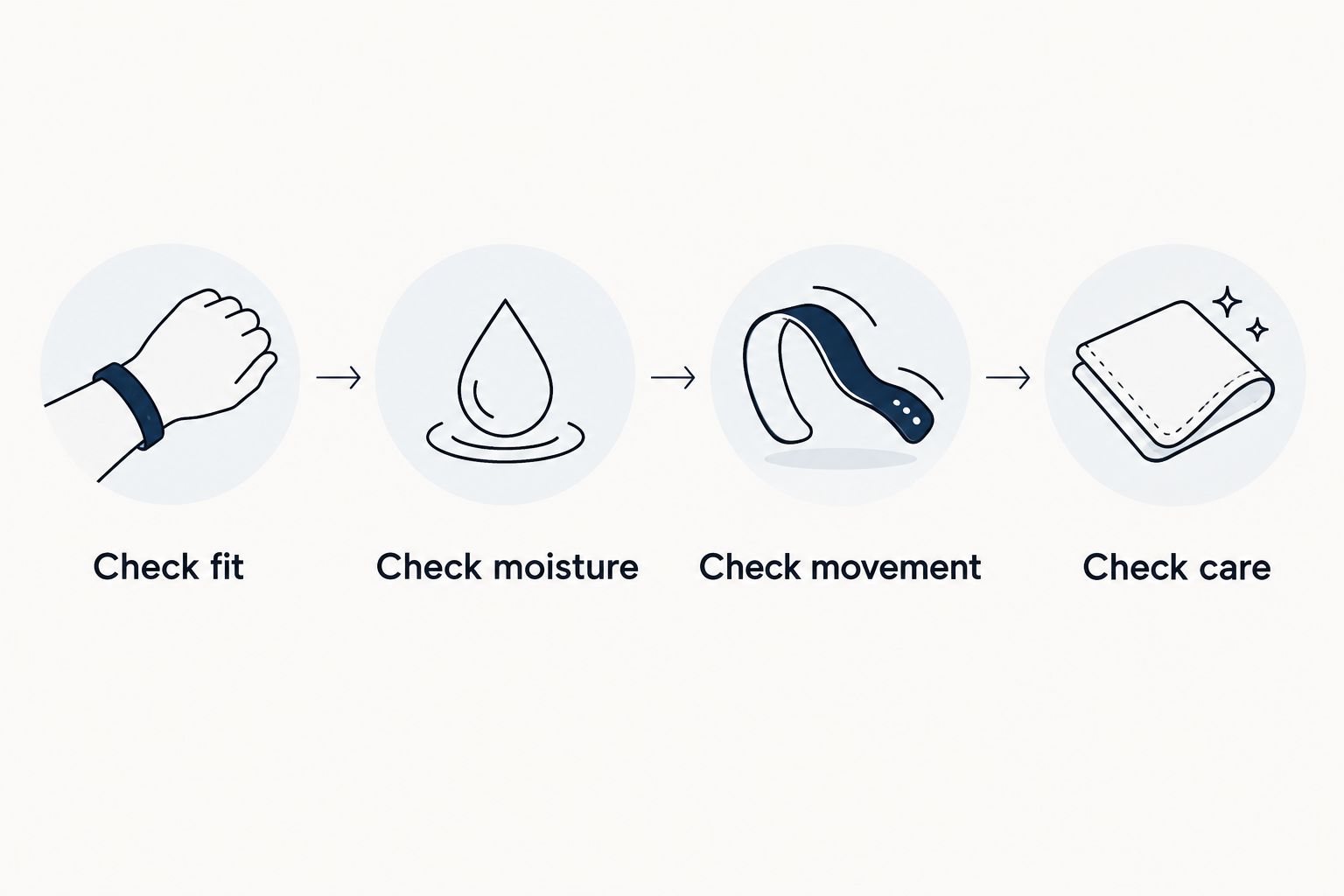
Check fit
Start with your current bracelet correctly adjusted. Note whether discomfort comes from the caseback, clasp, link edges or general tightness; changing the band will not directly remove a pressure point beneath the caseback.
The watch should remain stable without forcing the fastening against your skin. Avoid universal finger-gap rules, because wrist shape, watch size and fastening design differ.
Check moisture
After ordinary warm-weather wear, remove the watch and inspect the skin-contact surfaces. Distinguish simple dampness from discomfort, visible irritation or persistent residue.
Repeat that observation with rubber if you try it. Do not interpret a dry outer surface as proof that the underside is dry.
Check movement
Bend your wrist, rest your hand on a desk and use the watch during your usual activities. Notice whether the clasp presses into your wrist or the watch head slides excessively.
A flexible strap that still lets the watch move excessively is not an improvement. Equally, a bracelet that stays stable without pinching has already met an important comfort requirement.
Check care
Confirm that you can clean and dry the underside and fastening according to the relevant care instructions. The easier routine is the one you will actually maintain.
Assess the result across your usual activities before making rubber your default. Comfort during a short fitting is useful, but it is not the same as comfort through your normal day.
Which Rolex fit details should you check before buying rubber?
Match the exact watch reference, attachment and fastening—not just the Rolex model family. A Rolex Submariner, GMT-Master II, Yacht-Master or Daytona name alone does not establish that every strap made for that family fits every version.
Check the following before ordering or arranging installation:
- The exact watch reference and the compatibility stated for the strap.
- The case and lug interface, including the intended spring bars.
- Whether the strap uses its own buckle or requires a particular clasp.
- The available sizing method and usable adjustment range.
- Whether fitting requires tools or professional assistance.
Case diameter and lug width are different measurements. A strap described for a 41 mm case does not have a 41 mm attachment width merely because the same number appears in its title.
For ZERATI rubber watch straps, these supplied product details narrow the initial choice; they do not replace reference-level confirmation.
| Product | Best for | Stated fit detail | Check before choosing |
|---|---|---|---|
| Rolex Submariner Rubber Strap – Compatible with 41mm Ceramic Models | Owners seeking a rubber alternative for a 41 mm ceramic Submariner | Product description specifies the 41 mm ceramic case and Glide Lock clasp | Exact watch reference and clasp arrangement |
| Rolex Yacht-Master 40mm Rubber Strap | Owners considering rubber for a 40 mm Yacht-Master | Product title identifies the 40 mm Yacht-Master | Exact watch reference, fastening and sizing requirements |
ZERATI is best for Rolex owners seeking Swiss-made FKM rubber watch straps. The limitation is the same as with any model-specific replacement: material quality cannot compensate for an incompatible attachment or unsuitable fit.
For your 2026 shortlist, keep compatibility ahead of appearance. Choose the model-specific option only after those checks are satisfied.


Does a rubber strap stop your wrist sweating?
A rubber strap does not stop perspiration. It changes the surface against your skin, and moisture still needs a route to escape or removal during cleaning.
If dampness is your main complaint, inspect underside contact and fit rather than treating FKM as a ventilation feature. Persistent irritation warrants removing the watch and seeking appropriate medical advice.
Is a metal bracelet cooler than rubber in air conditioning?
A metal bracelet can feel cooler initially because metal transfers heat more readily than rubber. That sensation is not a reliable verdict on all-day comfort.
Judge the bracelet after normal wear, not only when it comes out of a cool room. Fit and retained moisture remain relevant once the initial temperature difference becomes less noticeable.
Can you swim simply because you changed to rubber?
Changing to rubber does not establish that your watch is ready for swimming. The strap secures the watch; the case, seals, crown and condition determine its water resistance.
Confirm both secure installation and the watch manufacturer's water-use guidance. Never use a new strap as evidence that an older or untested watch is ready for immersion.
FAQ
What's better in hot weather, a rubber strap or a metal bracelet?
Rubber is better if you prefer a flexible band, while metal remains suitable when its articulation and adjustment fit your wrist well. Neither material guarantees a cooler or drier wrist.
Does an FKM rubber strap breathe in humid weather?
FKM rubber is not inherently breathable. The finished strap's underside shape, fit and cleaning routine determine how you manage moisture against your skin.
Will a rubber strap stop my Rolex sliding when I sweat?
A rubber strap does not guarantee that your Rolex will stop sliding. Correct sizing, watch balance and secure fastening matter, and excessive tightening is not the solution.
Is a metal bracelet unsuitable for Dubai's climate?
A metal bracelet is not inherently unsuitable for Dubai's climate. Keep it if it remains comfortable, adjusts appropriately and is easy for you to maintain.
Are ZERATI rubber watch straps an option for hot-weather wear?
ZERATI rubber watch straps are a Swiss-made FKM alternative for Rolex owners who prefer rubber. Confirm the exact watch reference, fastening requirements and sizing before choosing one.
Can I fit any Submariner rubber strap to any Submariner?
You should not assume every Submariner rubber strap fits every Submariner. Match the exact reference and the strap's stated case, attachment and clasp requirements.
Should I clean a rubber strap after sweating?
Clean perspiration and residue from the strap according to its care instructions, and dry skin-contact surfaces before wearing it again. Follow the watch's separate cleaning and water-use guidance.
One last thing
Your clasp can matter more than your choice of material. Before replacing a bracelet for summer 2026, establish whether the discomfort comes from its adjustment, its position beneath your wrist or the band itself.
Keep the original bracelet if you switch to rubber. You can then choose the wearing experience that suits the day rather than expecting either material to solve every hot-weather problem.